The AI Flux
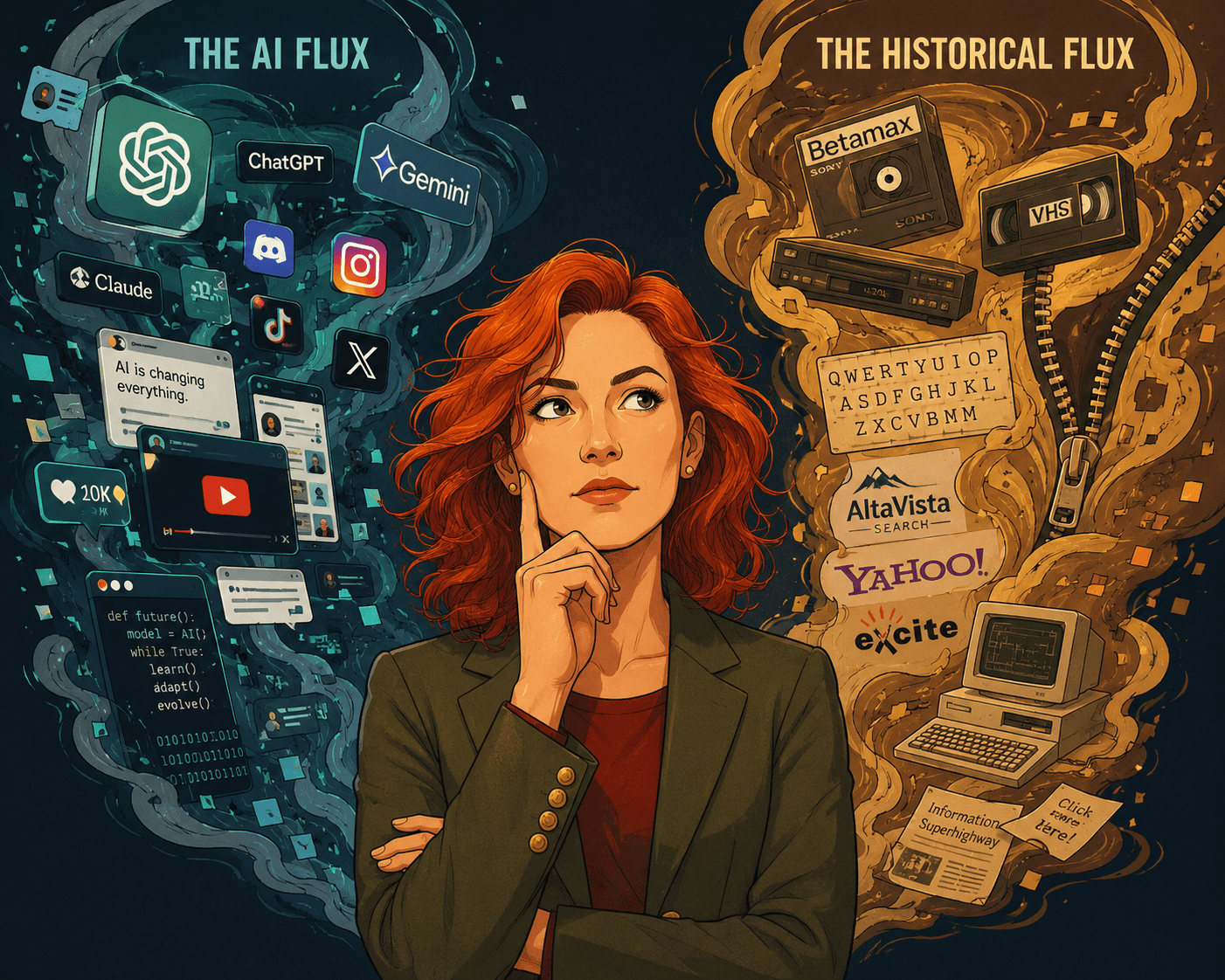
Why the influencers urging us to learn AI in five days are actually drifting with it — and what doesn't move under your feet.
I get sent these constantly. The reels, the carousels, the threads. An influencer telling me to get off social media and spend the next five days learning AI. Then another. Then another.
They are telling me this on social media.
For a while I tried to follow them. One course, then the next. A new framework. A new tool. A new "must-watch" five-hour playlist. The output went up. I built workflows. I shipped things faster than I had before. Measurably faster. There was real productivity gain.
But somewhere in the third or fourth round, something else set in. Not just fatigue.
The pace was not the problem
The companies these influencers were pointing me at were outdoing each other in a matter of days. The influencers themselves were learning at neckbreaking pace, saying the same thing in different ways, or different things in the same ways. The volume was enormous. The signal was unstable.
Every week brought a new agent framework, a new model release, a new "this changes everything" announcement. Every course I had taken last quarter referenced a tool that had been deprecated, redesigned, or absorbed into something larger. Every workflow I had built required maintenance just to keep functioning, let alone to incorporate the new capabilities I was supposed to be learning about.
I was running faster and arriving at the same place.
There is a name for this
Utterback and Abernathy, in their work on industry dynamics, called it the fluid phase. I used to teach it at Singapore Management University, where I called it the period of flux. It is the stage every major technology passes through before a dominant design emerges, before any standard crystallises, before the market has decided what the technology actually is.
In the fluid phase, competition is on functionality rather than cost. Entry is easy. Failure rates are high. Many designs compete; most disappear. The phase ends when one design — usually not the technically best, but the one that captures the network — becomes the standard. From that moment forward, the industry shifts into incremental refinement.
QWERTY beat Dvorak. VHS beat Betamax. The iPhone form factor beat everything else. None of those outcomes were obvious during the fluid phase.
AI is in the fluid phase now.
The transformer architecture is settled at the model layer, but everything above it is contested. Agent frameworks, application interfaces, deployment topologies, evaluation methods, pricing models, regulatory regimes, even the question of what an "AI product" is — all in active experimentation. There is no QWERTY for AI yet.
This explains the noise
This is why so many companies exist. This is why they outdo each other every week. This is why influencers proliferate. There is no settled answer for them to converge on, so they generate variants — some useful, most noise.
It is also why what you learn in five days may be useless in a few months. Tools will be replaced. Frameworks will be rewritten. The agent stack you built workflows on top of last quarter has competitors this quarter that work on different principles. Anyone selling you a fixed curriculum on a moving target is selling you yesterday's snapshot.
This is not a failure of effort. It is structural. No five-day course can teach a technology that will reorganise itself before the course is over.
The deeper danger is the drift
But the pace, exhausting as it is, is not the real problem. The real problem is the drift.
AI drift cuts in two directions.
The AI itself drifts. Models change. Capabilities shift. The behaviour of the same prompt is not the same six months apart. What you taught yourself to do with last quarter's tool no longer works the same way with this quarter's. Fine. That is the technology, and the technology is what it is.
The human drifts too. This is the danger no one is naming.
After enough rounds of letting the model finish your sentences, your sentences start to sound like the model's. After enough rounds of accepting the first plausible output, you stop noticing what is wrong with it. After enough rounds of optimising for the prompt that gets the result, you forget what the question was. Your judgment bends toward the tool. Your voice homogenises. Your attention shortens. Your originality, the strange and idiosyncratic angle that was yours alone, gets sanded down by repeated contact with statistical averages.
You become slightly more productive. You also become slightly less yourself.
Two drifts compounding against each other. A moving target tracked by a deteriorating compass. The technology won't sit still long enough for you to learn it. You won't sit still long enough to remember what you used to think. After eighteen months of this, you have shipped a great deal and become someone you do not quite recognise.
So what is the alternative?
Anchoring.
There are capacities that do not drift because they are not built on any particular model. They predate AI. They will outlast whichever architecture wins. They compound across every shift because they were never tied to one.
Reading deeply. Not summaries. Not threads. The actual book, with the actual difficulty, at the pace the writer intended.
Writing your own first drafts. Whatever you finally show the model, get something on the page first that is unmistakably yours. The drafts you let the model write for you are drafts you do not learn from.
Building one thing carefully instead of skimming twenty. Depth in any one domain — even an unfashionable one — produces judgment that cross-applies. Skimming twenty produces nothing that cross-applies to anything.
Defending your own ideas against your own scrutiny before any model sees them. The model will not push back on you in the way a serious mind would. You have to be that mind for yourself first.
These are slow. They are not five-day skills. They are not even five-month skills. They are the slow-built capacities that make you ready for whichever dominant design eventually wins — and that keep your judgment, your voice, and your attention intact while you wait to find out which one it is.
The inversion
Get off social media. Yes.
But not to learn AI in five days.
Get off to rebuild the attention span you will need to navigate a decade of flux. To recover the depth of thought that the fluid phase rewards. To keep from drifting with the very technology you are trying to learn.
The five-day course is the opposite of what the moment requires.
The moment requires the discipline of staying yourself while the ground moves.

Nhà giáo dục được đào tạo tại Harvard, cựu giảng viên toàn thời gian SMU, và là mẹ của năm người con — tất cả đều vào đại học trong khoảng 11 đến 15 tuổi. Pamela sáng lập All Gifted School dựa trên niềm tin rằng mọi đứa trẻ đều có năng khiếu theo cách khác nhau, và nhiệm vụ của giáo dục là đưa tiềm năng của mỗi đứa trẻ phát triển đến mức cao nhất.
Nếu bài viết này có ý nghĩa với bạn...
Những góc nhìn giáo dục khiến bạn suy nghĩ khác đi.
Tham gia cùng các bậc phụ huynh từ 10 quốc gia đọc các góc nhìn hàng tuần của Pamela về giáo dục, nuôi dạy con và bồi dưỡng học sinh tài năng.
Không thư rác. Có thể hủy đăng ký bất cứ lúc nào. Chúng tôi tôn trọng quyền riêng tư của bạn.