Denying Dyslexia
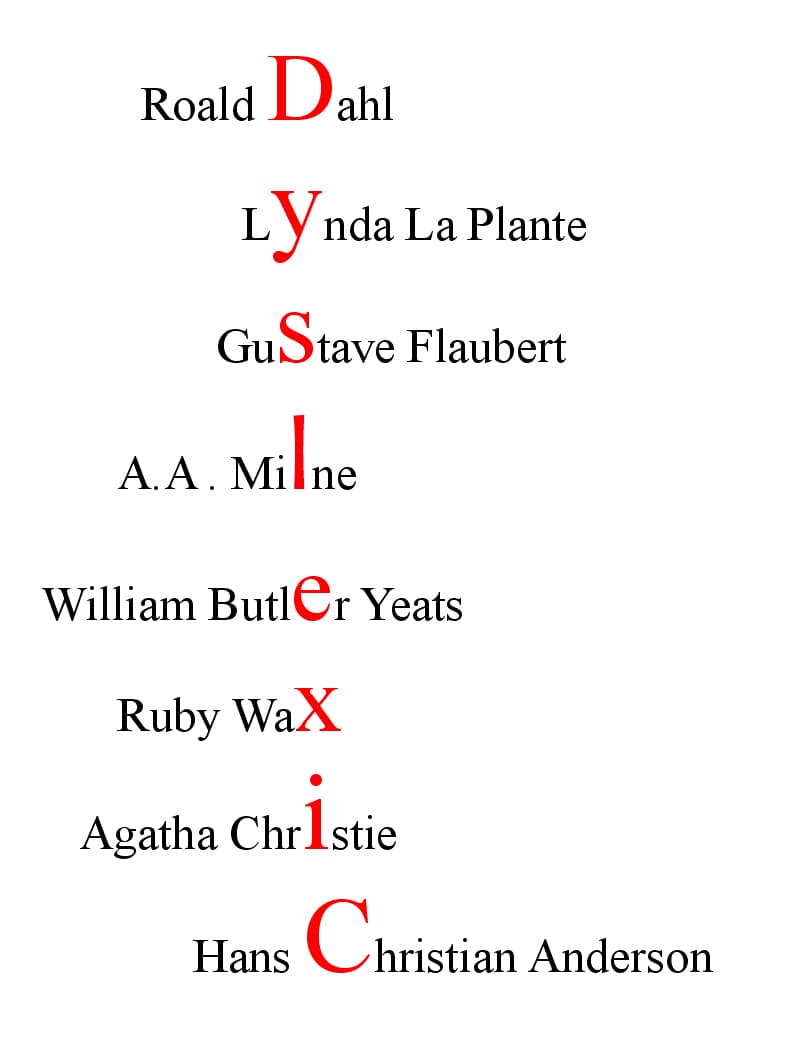
If not for the current dyslexia epidemic, I would never know that my mother has a 'learning disability', for though she speaks three languages and three dialects fluently, she still jumbles up telephone numbers and has great difficulty reading. I also would not have guessed that I have inherited the same from her.
You see, I still cannot tell my left from my right, have no hand dominance and don't believe in phonetics because I never learned reading through them. But I read perfectly and write better than many non-dyslexics, and I will explain to you how we learn.
I am blessed, for in our generation, we seldom hear of dyslexia, and I always thought my uniqueness was a gift rather than a deficiency and used them to the fullest while growing up.
Though my parents could not read any word with more than three letters, I figured how to read in English when I was just three. Nobody taught me phonetics. It was only later I realized I had a unique ability many dyslexic kids have: eidetic memory.
Eidetic memory is also photographic memory. Sadly, much as I wish I still have that ability, I realized it was gone when I was in my twenties. Researchers believe that this ability has nothing to do with intelligence and while I am not sure if that is true, I know that I depended on this to learn to read.
While other kids were learning how to pronounce and spell, I simply 'took photographs' of everything and drew upon this 'database'.
Learning to read words was not difficult, I stored the 'look' of the word and associated that with the word usage and its sound. When the same word is presented, I simply reproduce the sound. As I grew older, I figured what phonetics was and learned that by first learning words. So you see, the learning to read is reversed for people like me. We cannot learn phonetics and then read, we learn to read, figure out how phonetics work, and then learn to read other words using the phonetics.
Sadly, this taking photographs technique cannot last forever and for many, the photographic memory disappears at six. Some researchers believe it is due to altered memory processes. Fortunately for me, another skill evolved. With the loss of my 'internal camera', I learned to break big problems into smaller pieces to understand and solve small puzzles one at a time, because small pieces of solutions were easy to remember.
These days, I realized I am like other people, I process very similarly. Some people believe it is because we learned to compensate for our disability, I choose to believe it is not even a disability, but a different ability. And though I have read hundreds of academic journals and articles, gone through thousands of textbooks and millions of magazines, I still have not read a single novel. I still cannot finish a book properly. Since reading is still a chore (and ironically part of my job), I am choosy and I must find a reason to motivate me to read anything.
I often look at my own children and admire their abilities to read books, one of my sons can read 20 novels a day and regurgitates all the information. It is strange because by statistics, each of my children have a 40% to 60% chance of being dyslexic, meaning two or three of my children should inherit this from me. Yet none of them is diagnosed with this disability.
I kept my oldest son's P1 writing of his own name, his 'J' turned the wrong way, his 'a' looks like a 'p'. His '7' is laterally inverted. My youngest (#5) jumps from one line to another while reading. The psychologist told me my #4 has an eye-tracking problem and he would skip a line or two when he read. But you know what?
It did not matter one bit whether any of my kids is dyslexic or not, because it is not even important, it would not have changed one bit how I would have brought them up or taught them to read and write.
It was great I did not bother to second guess if they were 'disabled' and just kept exposing them to words, good books and good reading materials. They learned to read anyway, and way above their age level. If they had 'disabilities', i believe they would have found some ways to compensate them. My job was just keep on encouraging, making reading fun and providing great materials to them from young, so reading becomes a second nature and dyslexia cannot have a chance.
My son's psychologist told me that because his comprehension is so good, he is able to compensate his eye-tracking problem, for whatever he skips, his superior comprehension made up for the lack.
So if your child is really young, provide the right opportunities. If you want the child to have a great academic future, he/she needs to be able to read, so open those doors for that. Buy the books, go to the library, switch off the television, provide a good reading curriculum and read to the child cozily.
You will be so glad that even if he is born a dyslexic, nobody will ever need to know.
哈佛大学受训的教育者,曾任新加坡管理大学全职讲师,也是五个孩子的母亲——五个孩子都在 11 至 15 岁之间进入大学。廖秀梅基于一个信念创办了全资优学校:每个孩子都以不同的方式拥有天赋,而教育的使命,就是把每个孩子的潜力发挥到极致。
如果这篇文章引起了您的共鸣……
让您思考方式焕然一新的教育洞察。
加入来自10个国家的家长,每周阅读Pamela关于教育、育儿与培养资优学习者的深度洞察。
无垃圾邮件。可随时退订。我们尊重您的隐私。