How To Develop A Child To The Fullest
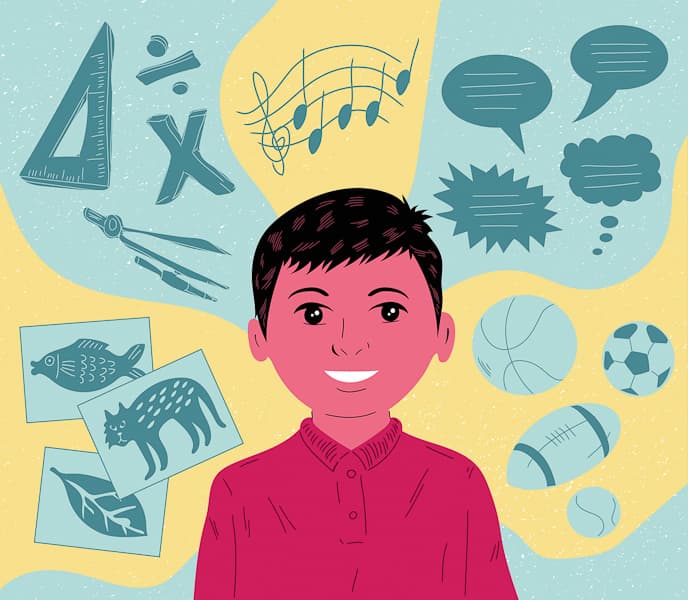

“Everybody is a genius. But if you judge a fish by its ability to climb a tree, it will live its whole life believing that it is stupid.” ~Albert Einstein.
I grew up thinking I was stupid, simply because I did not fit into the mould of a typically “intelligent” child. I chose to follow only certain instructions, made mistakes trying outrageous new things, questioned and dared to disagree. It was only when I started to run my own companies that I realised that these are not necessarily flaws, and that I do have some positive traits.
For decades, many people believed that giftedness meant a limited set of skills endowed upon an elite group of people. Yet, if we examine those around us, we can see that everyone has some kind of talent that cannot be measured by IQ tests, academic results or the schools attended.

People learn best when they feel they are in control, can achieve and see results.
According to Harvard psychology professor Howard Gardner, intelligence can be observed in at least nine areas: musical-rhythmic, visual-spatial, verbal-linguistic, logical-mathematical, bodily-kinaesthetic, existential, interpersonal, intrapersonal and naturalistic. I believe that we can maximise a child’s potential if we put effort into finding the areas he is gifted in, leverage technology to teach him by appealing to his intelligence, and spend more time honing his socio-emotional skills.
Throughout the history of schools, educators have been teaching as if everyone learns the same way. Yet, in a class of 30-40 students, it is hard to find any two who are the same. There will be kinaesthetic students who need to run around, existential students who have too many questions to ask, logical students who need to make mathematical sense out of every subject, and visual students who need to see the pictures in their minds.
People learn best when they feel they are in control, can achieve and see results. It is therefore best to build upon their natural giftedness when teaching something new. When a child is successful in learning in his strongest areas, he will also gain confidence to attempt things he is not naturally good at. A bodily-kinaesthetic child, for instance, needs to move around to learn. So forcing such a student to sit on the same chair for half a day won’t get anything into his brain. Giving him reasons and responsibilities that get him off his seat will motivate him better.
When my son was in kindergarten, he was allowed to walk around the classroom while the teachers taught. When the teachers were done, he could regurgitate everything from the different star constellations to the Seven Wonders of the World, and he was never a difficult student. But when he went on to primary school, he was asked to sit still. He first tried to disturb his friends, then fell asleep most of the day and eventually learned nothing much in school for the next four years.
To cater to children of different needs, many schools around the world are embracing technology. E-learning, videos, games and demonstrations can be used to provide customised learning materials to appeal to children who learn differently. For example, a visual-spatial child can learn quicker when the lessons are presented visually through videos or demonstrations. A verbal-linguistic child can learn mathematics through reading about numbers, a naturalistic child can learn through linking mathematical concepts to nature, an interpersonal child can do activities that appeal to his needs to connect to a larger group.
With technology taking over some of the mundane curriculum delivery, educators can spend more time looking into the students’ psychological, moral, social and emotional needs. Rather than being saddled with delivering academic subjects, teachers are released to connect with the students and teach them what technology cannot: empathy, values and life skills.
Every child (and for that, every person) is a gem, and if we take the effort to discover his gifts, use technology to leverage his gifts to deliver lessons to him effectively, and spend time to nurture the soft skills, then in everyone there is a good chance he can achieve even what his mind’s eyes cannot see.
Pamela Lim, a mother of five, is an entrepreneur and a former lecturer at the Singapore Management University for entrepreneurship and innovation. She runs the online All Gifted High School, which offers courses for homeschooled and school-going children. For more on Howard Gardner’s multiple intelligences: bit.ly/MI_gardner
- POSTED ON
Jul 2, 2014
- TEXT BY
Pamela Lim
- ILLUSTRATION BY
Mushroomhead

哈佛大学受训的教育者,曾任新加坡管理大学全职讲师,也是五个孩子的母亲——五个孩子都在 11 至 15 岁之间进入大学。廖秀梅基于一个信念创办了全资优学校:每个孩子都以不同的方式拥有天赋,而教育的使命,就是把每个孩子的潜力发挥到极致。
如果这篇文章引起了您的共鸣……
让您思考方式焕然一新的教育洞察。
加入来自10个国家的家长,每周阅读Pamela关于教育、育儿与培养资优学习者的深度洞察。
无垃圾邮件。可随时退订。我们尊重您的隐私。